The SD Series: Master Controller

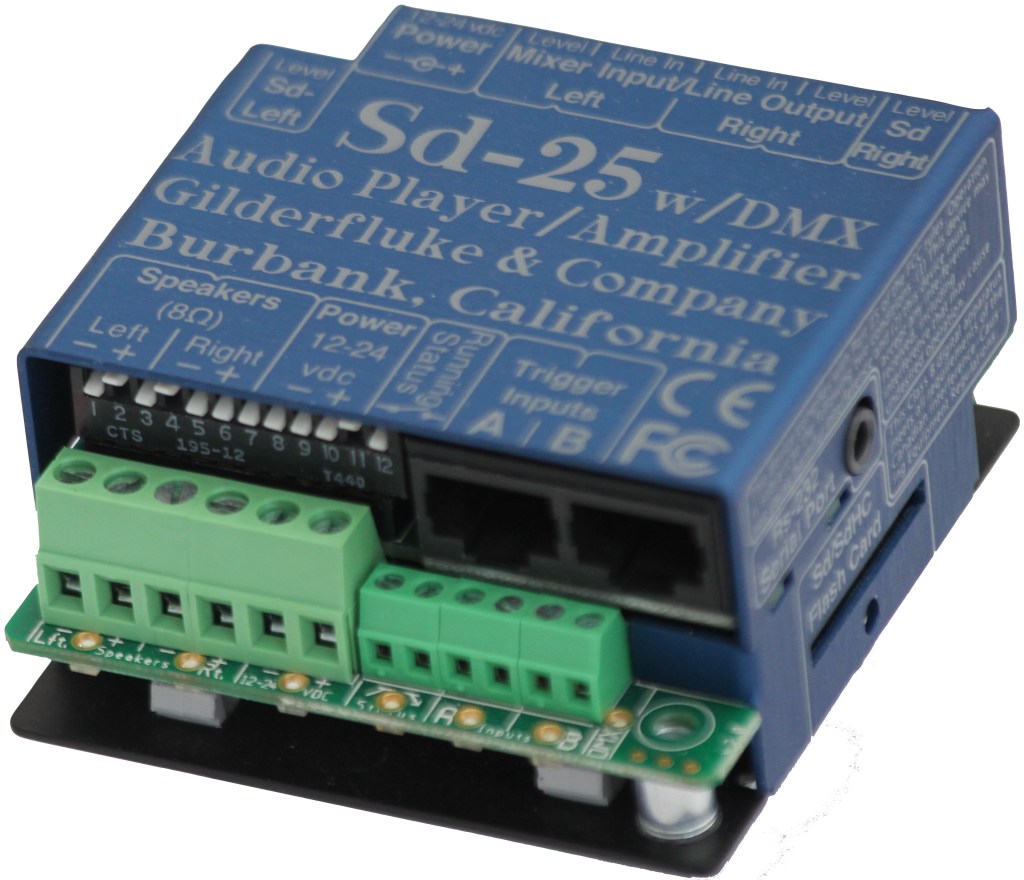
The Gilderfluke & Co. “Sd” Series (SD-50, SD-25, SD-10) and “Amp-50” are our industrial grade audio players and amplifiers.
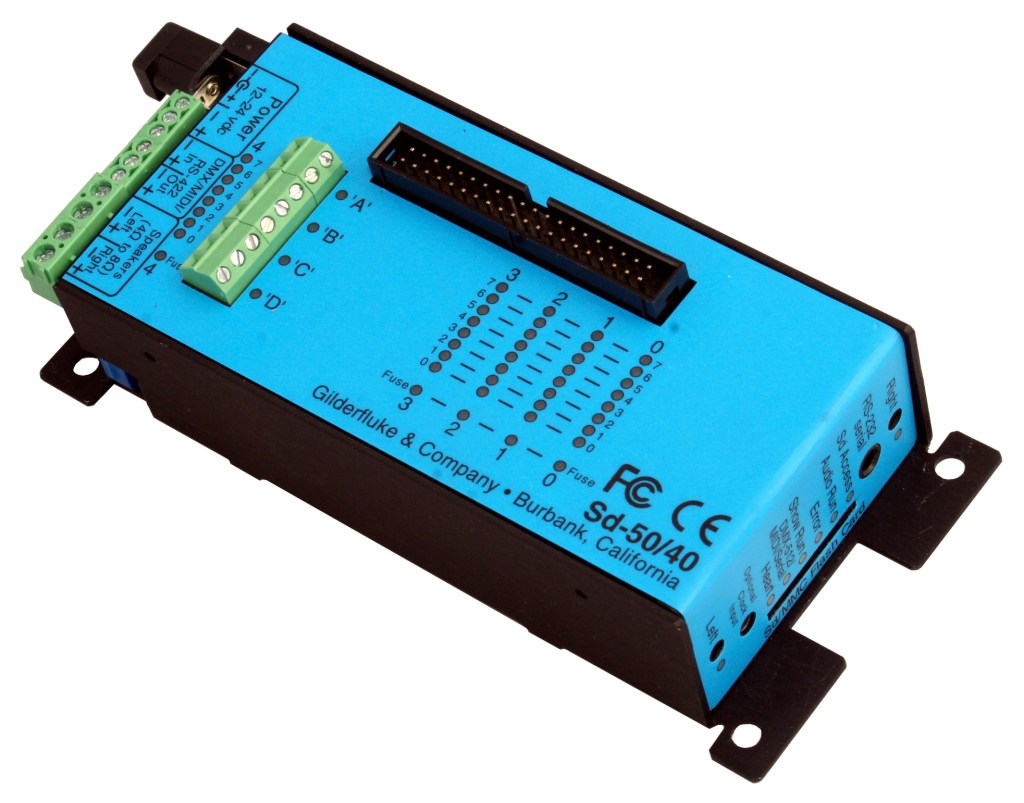
The SD-50/40 is a customer favorite!


Introduced to supersede our previous ‘Mp3-“ line of audio players, the SD players all use standard SD (Secure Digital) flash cards for storing audio content. ‘Industrial’ grade SD cards are recommend for the greatest long term reliability. The SD line of players all support both .Mp3 and most .WAV formats ( up to 16 bits and 44.1K sample rate).
As with all GilderGear, our SD products are designed and built in the U.S. (mostly in Southern California). This allows us to improve each item on every production run, while still retaining both backwards and forwards compatibility with other units.


Also, as the sole manufacturer, we are able to customize them, if the ‘stock’ units don’t do exactly what you need.


With our background in the themed entertainment industry, the SD’s and Amp-50s were built from the ground up to be ‘Roller Coaster’ tough.


If you think about what it means to be  bolted to the back of a roller coaster, they have to stand up to near constant vibration, and positive, negative and sideways G-forces that regularly reach into the double digits. That little connector that weighs only a few ounces can instantly transform into a monster that weighs pounds.


In addition, roller coasters are rarely indoors, so they are exposed to extremes of temperature and weather ranging from the deserts North Africa to the winters near the Arctic circle.


All of our production PCBs are built with gold plating. Any connector that is available with gold plating will be purchased with gold plating. Why do we do this? Because gold doesn’t rust.

‘I love goooooooold’


Although we don’t recommend it, but each year we get a few pieces of GilderGear returned for repair that have been run underwater. One major Southern California theme park discovered that they had been running a Br-miniBrick8 and SD-25 underwater for more than half a year. The client dried them out, wire brushed off the white scale that the water had left, and returned them both to service.


Some of the GilderGear on the Queen Mary had been running for 25+ years without a hiccough, when a pipe ruptured and filled the bottom of the boat with raw sewage. This inundated dozens of Gilderfluke & Co. show controllers and audio players. It took some time to pump the sewage out of the boat, so the equipment was submerged in sewage for quite a while. Hazmat cleanup not being one of our specialties, we weren’t anxious to see any of this GilderGear on our dock. When the Queen Mary’s insurance paid off, they were able to purchased all-new GilderGear to replace the gear that had been fouled.
If you short circuit the animation or amplifier outputs of the Sd units, they simply turn off until the short is removed, and then instantaneously go back to working normally. One client saw us demonstrating this at a trade show using a screwdriver on an SD-25’s speaker terminals (which makes a nice little spark for added visual effect). He had a problem with the large rack-mounted amplifiers used in his miniature golf facility. Several times each year, someone breaks a sprinkler head, and it floods his speakers. His original amps would then blow their outputs, and have to be sent back for a factory repair, which usually takes about six months and $500+. He replaced all his amplifiers with Amp-50s and SD-25s. At the next trade show, he reported that now when a speaker gets wet, our amplifier just turns off. He fixes the sprinkler head, drains the speaker, and when the afternoon sun dries the speaker sufficiently, the amplifier just starts working again.

Oh my, Queen Mary!


At full output, our digital amplifiers draw about 2 amps at 24 vdc. If you do the math, this works out to about 50 Watts. They only rarely draw this much current, because they only draw as much current as they need for the level of the sound they are putting out through the speakers. During quiet parts of your show, they will only draw milliamps. If you put an ammeter on the power input to one of our amplifiers, it will look just like a Vu meter, following the instant by instant current draw of the speakers.


Our digital amplifiers are all 90+% efficient.


Approximately 90% of the power they receive goes to the speaker, and somewhere under 10% is wasted in the amplifier. This compares favorably with 20% efficiency found in linear amplifiers. From the moment you turn on a linear amplifier, the vast majority (80% ) of the amplifier’s rated power is wasted by the amplifier in its heat sinks and fans, and a maximum of 20% of the amplifier’s rated power ever reaches the speaker.


Just how big of a speaker can you run with our digital amplifiers? The physical size of a speaker doesn’t really matter. What does matter is the impedance of the speaker. If the speaker has a rated impedance of eight ohms, then you can easily run a pair of them from an Sd-25 or Amp-50, or four of them from an Sd-50. If you try to drive these amplifiers beyond what they can safely provide, they will simply turn off during the audio peaks. If this happens, first make sure it isn’t your power supply glitching. If the power supply is OK, you may need to increase the supply voltage to 24 VDC (if you were running at lower voltage than that) turn the volume down by a little bit, bridge the amplifier, or add additional amplification.

California Science Center–Whew! Look at that Center– filled with science! What a stupendous place!


We recently completed a retrofit of an earthquake simulator at The Los Angeles Science Center. Along with a moving floor, strobes, video,lights, etcetera that we now control, this motion simulator has a pair of Cerwin-Vega SenSurround subwoofers. Thousands of these speakers were built as part of a novelty speaker system MCA/Universal created for movie theaters in the days before LucasFilm’s THX. Who can ever forget the epoch 1974 film Earthquake, or Midway (1976), Rollercoaster (1977), Saga of a Star World (1978), or the compilation film Mission Galactica: The Cylon Attack (1979)? These were all made to show off the miracle that was SenSurround during its five year lifespan.

Cerwin-Vega SenSurround Subwoofers!


Because it wasn’t possible to reproduce low frequencies on film prints, the SenSurround system used a pseudorandom noise generator with output frequencies between 17 and 120 Hz to feed 1,600 watt BGW-750 audio amplifiers driving the eight ohm subwoofers. We sampled the rumble from the pseudorandom noise generator, and put it onto an Sd-25. We then attached the two stacked 4′ x 4′ x 30″ SenSurround subwoofers to one Sd-25’s stereo amplifier terminals. They are louder than the original hardware, as indicated by the 8 foot tall subwoofer stack ‘walking’ for the first time since they were installed 22 years ago.


We have clients that have emptied out racks of linear amplifiers and replaced them with our digital Amp-50s, and used the energy savings to pay for the upgrade. They tell us that the break even point was only about two to three years.


In one museum retrofit, we have replaced a half a rack of Crown and Rane Amplifiers (5000 Watts worth) with five Sd-25s and three of the Amp-50s. We carefully measured the peak SPL for each of the eighteen individual speakers, so that we could easily match the original mix after replacing the audio system. It is a fairly loud show, with a peak of 105 dB at the center of the room with all eighteen speakers pumping. When we fired up the first Sd-25, we set the level controls to about 50% as a starting point. With just the first two speakers running, we hit a center of the room SPL of over 110 dB (which is where my meter pegged out). We had to set all the amp’s levels to 10% or 15% just to keep the overall show below 105 dB.

When we send Sd-25s out on evaluation loans, we always warn integrators to:

  1. Use two good sized speakers (rated for a minimum to 175 to 200 Watts continuous power each)
  2. Load some all-digital music (free from hiss and other analog artifacts) onto an Sd card
  3. Take it outside so you don’t break any windows when you
  4. Crank it up loud!

Another major theme park company with attractions in Orlando, Los Angeles, and other parts of the known universe purchased two Sd-25s from our first production run, just to try and break them. First they strapped them to the back of pair of ‘racing’ rollercoasters, where the G-Forces at their highest. After several months of this, they ran them on a paint shaker for a few more weeks. After surviving  these tests, they sent them to an independent ‘G-Force’ testing lab, where they were attached to a pendulum and repeatedly swung into a large block of concrete. Since they couldn’t break them, they have used GilderGear on most of their subsequent rollercoasters and ride vehicles.
That same entertainment company recently went through the maintenance records for all of the thousands of pieces of GilderGear they had installed in Orlando over the last 30+ years. They found that in all of that time, they have yet to replace a single piece of GilderGear because it failed in service. They have broken a few things, and upgraded a few things just to get the newer features, but they have yet to have a single piece of GilderGear just break. They have ordered more than 2000 pieces of GilderGear from us in just the last 12 months. 


If you think about what a rollercoaster does, is it runs at high speeds on a (usually) steel track on (usually) non-conductive wheels. Although most people think of them as fun things to ride, but they are really just big Van de Graaff generators!

Gilderfluke can keep your rollercoaster running for eons and eons!
Photo by Aidan Roof on Pexels.com


In most cases, rollercoasters are built with ’static discharge’ brushes at several points around the track so they don’t electrocute their guests as they scramble in or out to the cars. One major park in the Orlando area that didn’t install static brushes found that they had a reliability problem with a standard wired DMX-512 (Rs-422) lighting network that connected the rollercoaster cars together in each train. When the integrator tried to measure the voltage that was being built up on the trains, they found that a static potential meter was ‘pegged’ at a voltage that was too high for it to measure. The clue that should have told them that there was excess static electricity being built up on the moving vehicles were the loud pops and crackles each time the brake plates passed through the eddy current brakes along the track.


Another amusement park in South America had a similar problem when they were preparing their coaster for the upcoming ‘summer’ season. After running flawlessly for several years, they were having sporadic problems with the Sd-25s in their onboard  audio system. I asked them if anything had changed on their rollercoaster since the previous season. They answered ’no’, other than repainting. With that, I asked them to find the aluminum plate(s) along the track that the static brushes use to discharge, and sandblast the paint off the working surface. This instantly fixed all of their problems with static discharges.


The members of the SD Series and Amp-50  family of products are:

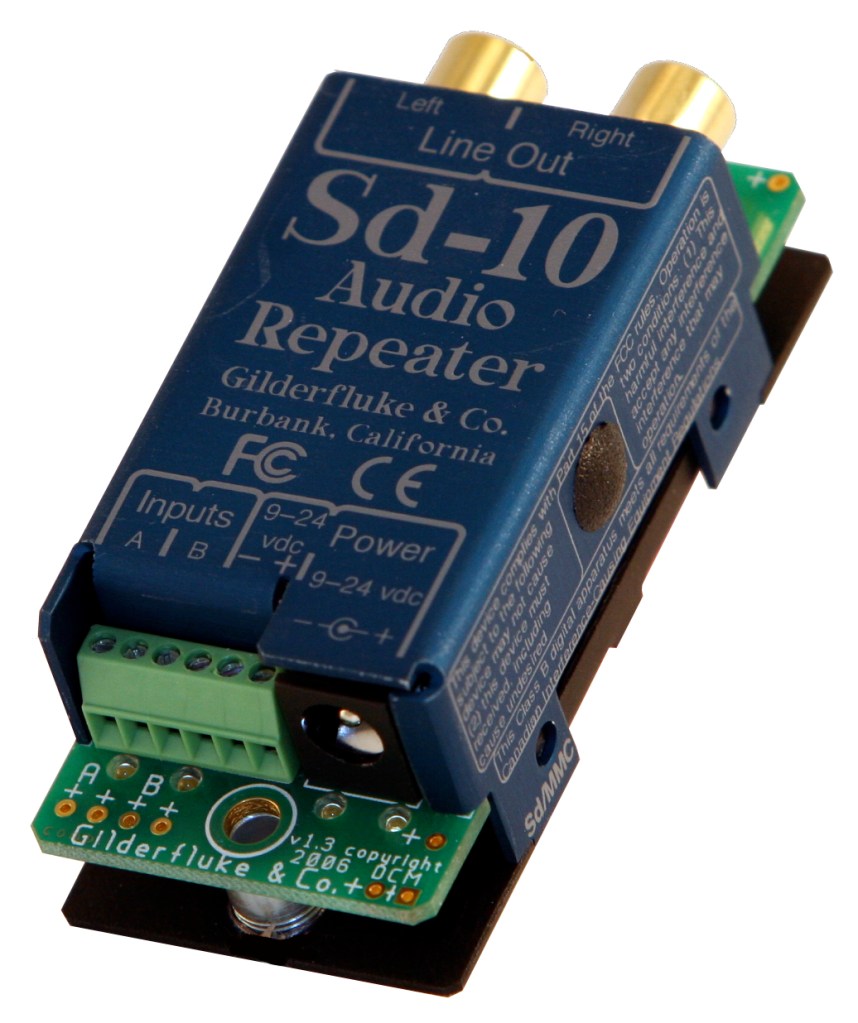
  • Sd-10: At about the same size as a 9 volt battery, this little audio player has stereo RCA jacks for connecting to an external amplifier or headphones. .Mp3 or .WAV audio is stored on standard Sd cards, and can be played back continuously, or only when triggered by either of its two optically isolated, non-polarized inputs. An Rs-232 serial port is optional, and can be used for volume control or selecting and playing sound files. The Sd-10 is basically the audio player half of and Sd-25, but without the built-in amplifier (see Sd-25 below).
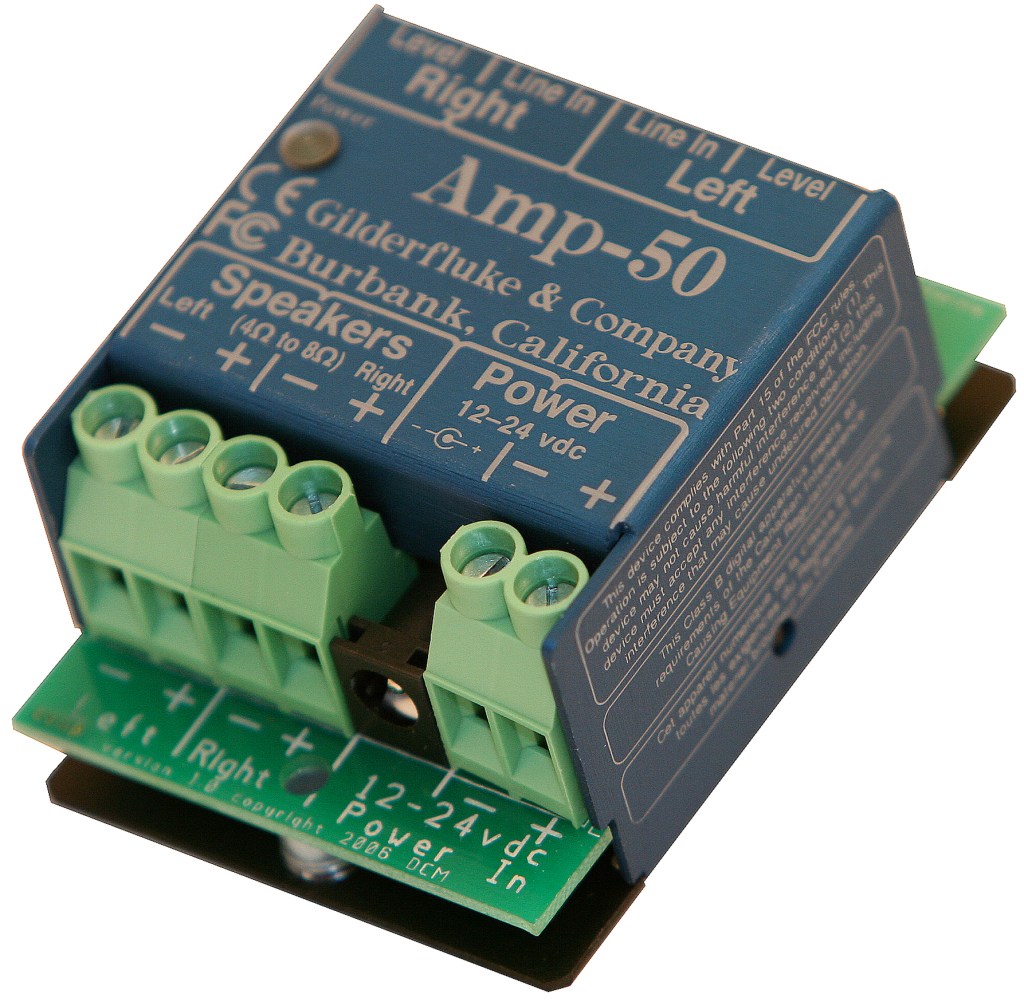
  • Amp-50: This amazingly powerful Class-D amplifier is equivalent to a 200-250 Watt linear amplifier. It runs on 12 to 24 VDC, so some clients use them in custom auto sound installations as well. The ‘Golden Ears’ at both of the largest entertainment companies in the world both have specified Amp-50s in their major permanent attractions, which tells you a lot about just how good these amplifiers sound. 
  • Sd-25 w/DMX: This combines the audio player from the Sd-10 and the amplifier in the Sd-25. Just attach a pair of speakers and a 12-24 volt power supply (or batteries), slide in an Sd card with some SoundFiles on it, and it is ready to run. It comes standard with an Rs-232 serial port, two DMX-512 in/out/thru ports, IR port and two non-polarized optically isolated trigger inputs. Two line level RCA jacks can be switched for line in to mix additional audio into the Sd-25, or line out if you want to send the audio from the Sd-10 to an external amplifier. The Sd-25 is a complete standalone audio system that is slightly smaller than the size of a standard post-it note. 
  • Sd-50/0: This is an audio player like the Sd-25, but with two Amp-50s built in. This gives it the equivalent power of a 400-500 Watt linear amplifier. For triggering the SoundFiles, there are eight optically isolated inputs, as well as an Rs-232 Serial port.
  • Sd-50/8: These are the ‘Everything-But-The-Kitchen-Sink’ Show Control Systems. Like the Sd-50/0 above, but adds show control with eight medium current outputs, 512 channels of lighting control via DMX-512, PCM control of up to eight ServoMotors, four non-polarized trigger inputs, 365 day scheduling, and even an input for a GPS antenna to keep it locked to the universal standard time and synchronized (within 1/1000 second) with every other Sd-50/xx on the planet. The Sd-50s with the GPS option are often used on clock and carillon bell towers at schools and houses of worship. One town has two different churches that use these for their bell towers, and they strike and toll in perfect sync with each other, even though they are miles apart. If you need more show control outputs, you can use an Sd-50/40, or network additional GilderGear using DMX-512 for up to 4096 on/off ‘Digital’ outputs on each network.
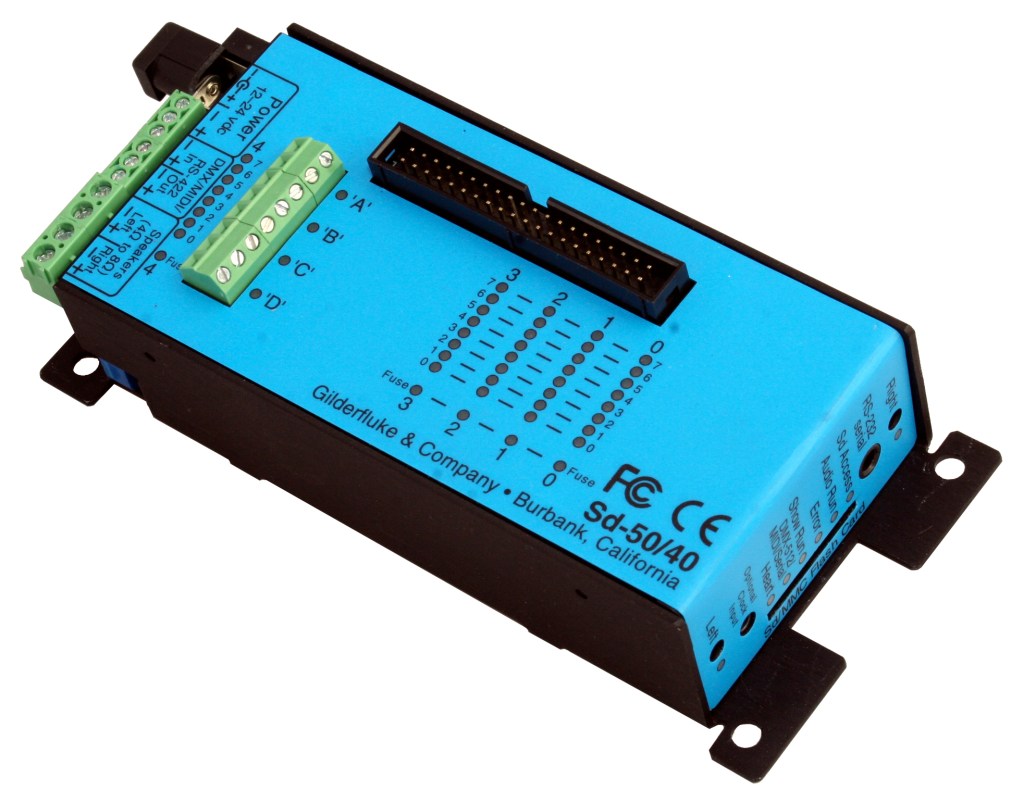
  • Sd-50/40: Like the Sd-50/8 above, but has a larger kitchen sink with forty medium current outputs.

GilderGear is used in:

  • Theme Parks
  • Museums Displays
  • Water Parks
  • Safety Announcements
  • Haunts
  • Training Simulators
  • Escape Rooms
  • Stage Productions
  • Operas
  • Film Production
  • Gimbal and Motion Base Controls
  • Houses of Worship
  • Animatronics Controls
  • Vehicle Sound Systems
  • Holiday Light Displays
  • Fountains Controls and Programming
  • Splash Pads Controls and Programming
  • Fine Arts
  • and more

— Doug Mobley, CEO and Owner of Gilderfluke & Co.
SER-DMX for Advanced Animatronics

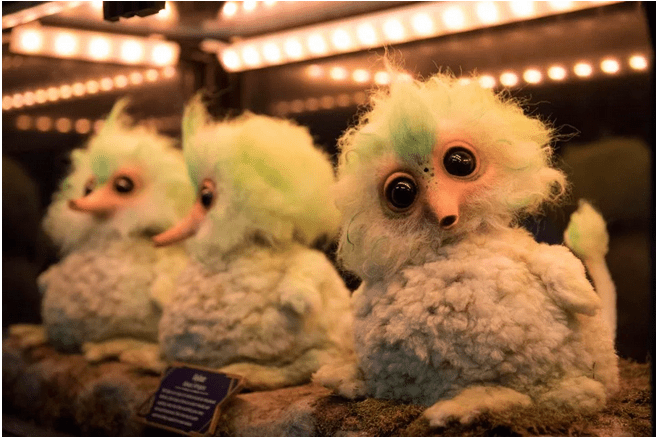
Do you have a tiny cutie begging to come to life? The SER-DMX can do it, while still keeping it lightweight and natural.

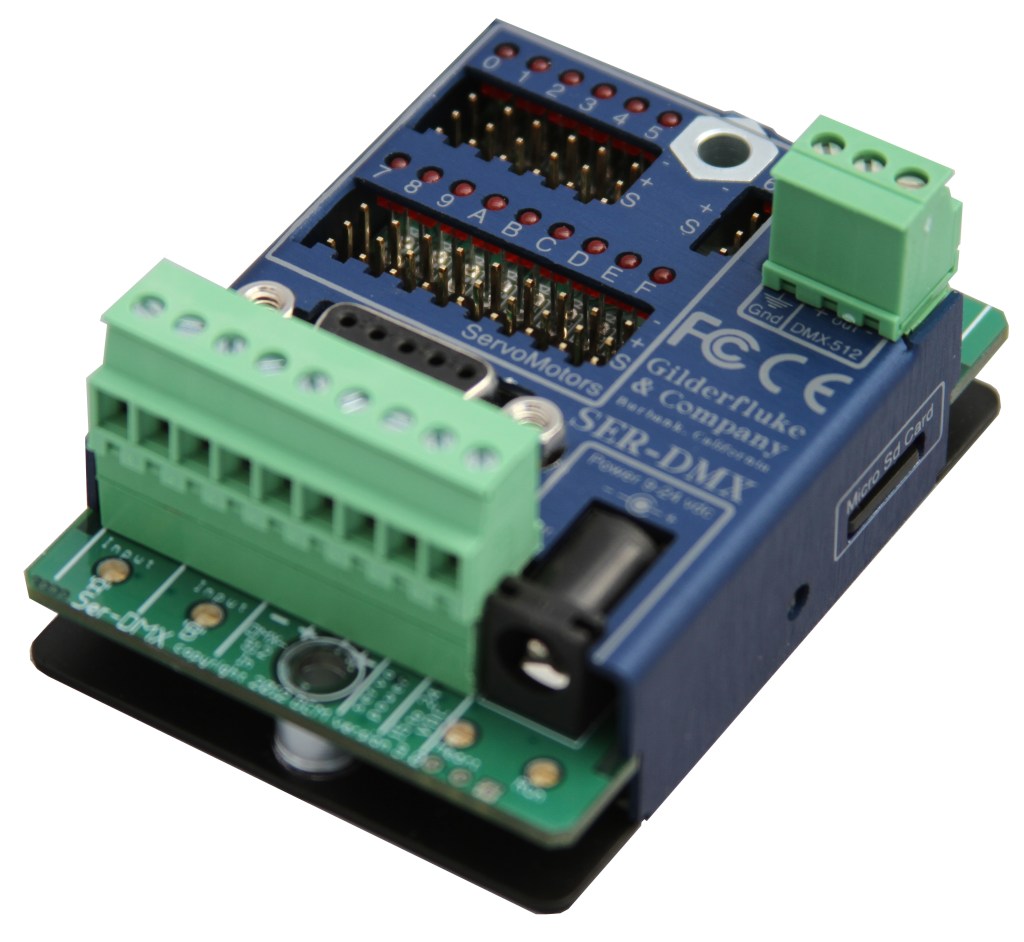
Our SER-DMX has had a long and storied life here at Gilderfluke- moving up several generations, it’s third and current iteration has moved it from the SD family into the miniBrick family (meaning it is now more dynamic and multi-functional than ever before)! The first generation of the SER-DMX was a set of timers with sixteen 0-10 analog inputs and ServoMotor outputs. The second generation had a micro controller CPLD generating a pulse for talking to Servo’s and was a DMX slave device. The third and current iteration of the SER-DMX is used for controlling remote control-style ServoMotors from its micro Sd card, or from any Gilderfluke Animation Control System or other DMX-512 source (check out our SER-DMX ‘facts’ below for further detail!). ServoMotors are an inexpensive way to add analog movements to animated figures. Using analog controls allows for smoother movement and control.

SER-DMX in all it’s glory

SER-DMX FACTS!

Digital or Analog? We have changed the SER-DMX to analog movements from primarily digital. To give a little background- A digital device is either on or off, like a light switch. An analog device is on, off, or at any point between. A common example of an analog device is a lamp dimmer. In animation, analog movements give the fluid, lifelike movements that are needed to bring an animated figure to life. Analog movements can be moved as quickly or slowly as you desire, and stopped at any point within their range of movement. Features of the SER-DMX include:

  • The SER-DMX controls up to sixteen remote control-style ServoMotors. These use a Pulse Code Modulated (PCM) command signal with pulses that typically vary between 1.0 and 2.0 milliseconds to give you a 90° ServoMotor shaft rotation. Each ServoMotor output can be adjusted anywhere between .5 and 2.5 milliseconds, or even reversed. Depending on your ServoMotor, this can give you up to 180 degrees of movement. The ServoMotor endpoints do not interact during adjustment.
  • Accepts eight or twelve bit resolution commands from your Pc•MACs Animation Programming System.
  • Built-in Ease-In when shows or DMX-512 starts or stops. These keep the ServoMotors from jumping.
  • Networkable! The SER-DMX can act as a ‘master’, sending up to 512 channels of DMX-512 data to other GilderGear and DMX-512-compatible equipment that act as a ‘slaves’, or the SER-DMX can receive DMX-512 from an external source, and itself be a ‘slave’. Error checking prevents any updates from bad DMX-512 data. As a ‘Master’, the SER-DMX has the DMX-512 output capacity to run most shows.
  • Micro Sd Flash card for a virtually unlimited show capacity. Up to 255 shows can be loaded onto a SER-DMX at one time. In many installations, the SER-DMX can take the place of a lighting board.
  • Indicator LEDs for heartbeat, trigger inputs, ServoMotor outputs, and DMX-512 status.
  • Two optoisolated inputs or the RS-232 serial port can be used to start, stop, or access shows.
  • The SER-DMX cards can be mounted in ‘inaccessible’ locations, since they are Controlled and Configured through the RS-232 serial port.
  • The SER-DMX runs on 7 to 24 vdc. ServoMotors typically use 4 to 6 volts. Some ServoMotors use up to 12 or 24 vdc. If using ServoMotors that need more than seven volts, you can run the SER-DMX from the same supply as the ServoMotors.
  • Identical in size and shape to a Br-miniBrick8. Can be mounted on Snap-Track, DIN rail (using the optional DinAdapt clips), or just screw or velcro it to the backside of whatever it is controlling.

Story time! “Take it away, Ern’!”

Before he was able to talk to Ernie in the Knight Bus

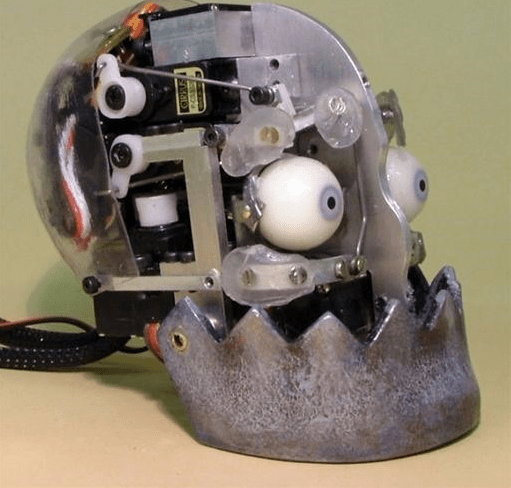
The SER-DMX is used in all sorts of props and animated figures for movies, theme parks, haunt and home hobbyists the world over. It’s especially useful if you have a lightweight animatronic, the SER-DMX is about the size of our miniBrick8 (about 2×2.5x.75”) so you’re not weighed down by bulky hardware. One of the more fun examples is about that shrunken head in that magical movie based on a series of magical books about a British boy with a lightning bolt scar on his forehead! The shrunken heads are particularly well-known as they were not in the books, but added in the movies- a unique curiosity for fans who were used to elements being removed from the original story line, not added.

Story goes, the props department was messing around with fun background ideas to make the movie visually spectacular. The grand wizard herself, JK Rowling came in on one fateful day- noticed the shrunken heads and loved them. As a result, they got moved up from a static background prop to an animated full-frontal addition to the movie! This is an especially good example of a small animatronic using the SER-DMX seamlessly- most viewers don’t even realize the puppet required no CGI at all- it was purely practical!

Props for the movie used our PC-MACs software, which at the time, the props team wasn’t super familiar with. So one of the props heads brought our manual home one night (probably as a way to lull her to sleep after a long day ) and discovered the ‘Yak’ function in the manual. As one might assume, the Yak function allows for easy programming for mouth movement. The next day she put the Yak function to work and BOOM! Movie magic. The director loved it, the movement was seamless and- it’s worth mentioning twice- didn’t require a touch of CGI. You can thank that PC-MACs software for those shrunken, moving lips when it projects, “Take it away, Ern!”, among other quips.

The SER-DMX brought a large swath of props to life for the movie series far beyond the infamous shrunken heads- most of which we cannot disclose here, or we would have to wipe your memory. It is also used in theme parks, restaurants, and stage shows all over the world! Interested in one for yourself and your creations? Do you have any specific questions? Don’t hesitate to contact us!

Whew! Look at the jaw/eyeball combo!

If your eyeballs are tired and you no longer want to read- but still have a desire to learn- check out our related Brown Bag Seminars below!

Get up to speed on the DAC-Quad for next week while you learn more about the SER-DMX and our super useful Br-ANA!!
Interested in the rest of the miniBrick family? A lofty Brown Bag Seminar for your pleasure!

Want to buy all of our products? Please do! Or just get the SER-DMX!

Join us next week as we jump into the wild world of the DAC-Quad!

Read up on Previous posts below!

Halloween Decor with Gilderfluke & Co!

Your Halloween decor can be so much more than Target decorations! Sick of buying those battery-operated decorations year after year? Adding in the use of GilderGear will take your decorations up to a whole new level! Halloween decorating is one of the few things available to us in 2020- it’s a fun at-home project that…

Haunt Marketing 2020 Q & A with Laura Kilpatrick

Thank you all for tuning in for another Halloween Haunt article! This week we have another Q & A with a focus on the Marketing side and the changes made for COVID this year. Today we are featuring Laura Kilpatrick- a Graphic Designer by trade and an Art Director at FearWorm Hauntvertising, specializing in Social…

Haunt in the World of COVID [REPOST]

Originally Posted On September 16, 2020 In a year where nothing is going right, it’s hard to find a silver lining to 2020. With dozens of theme parks shut down and even the entertainment behemoths like Universal and Disney struggling, everything seems to be in freefall. As we move closer and closer to October, us…

The Br-miniBricks 4 & 8: Animatronic Dreams Realized

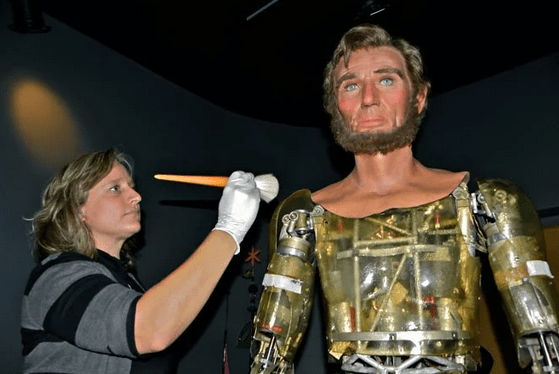
Anyone else getting Westworld vibes from President Lincoln? All those guts in there are easily controlled by the Br-miniBricks! Lincoln would be better adept for the miniBrick8.

Our miniBricks are your key to complete show control! These little bricks of might have been used in the world over in all things animatronic, costume, droid, light control and general show control. If you need animation- the miniBricks got you covered.

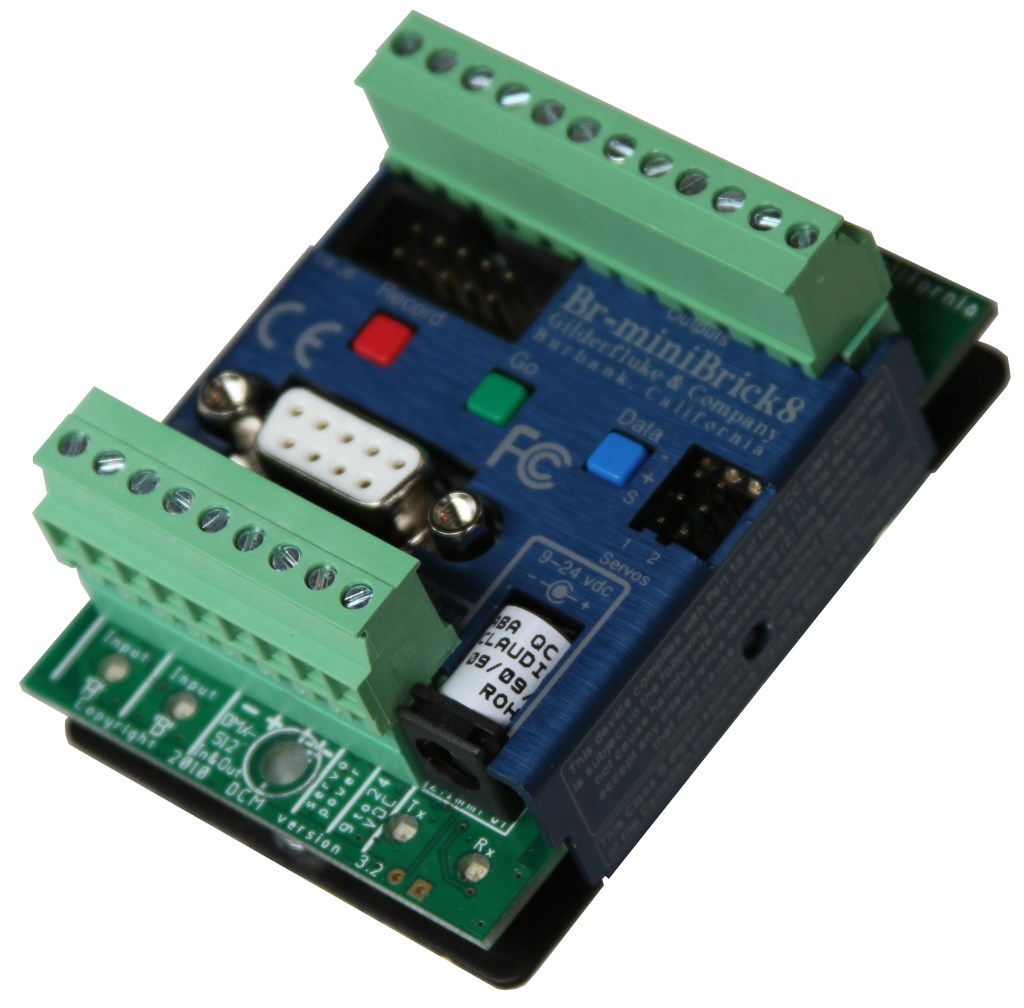
Let’s get the technical bits out of the way, starting with the Big Daddy of show control, Br-miniBrick8:

This guy is built to last! He (or She) is that long term partner you’ve always dreamed of!

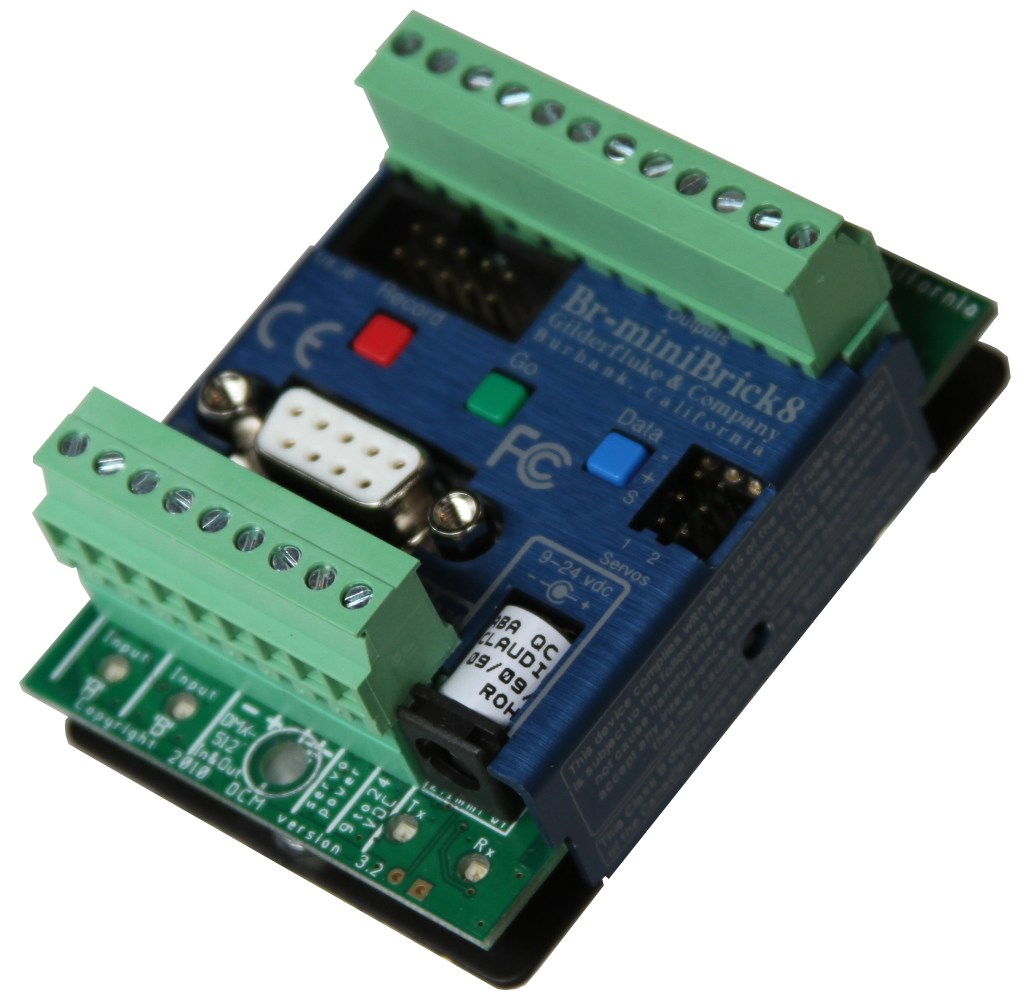
The Br-miniBrick8 is a complete stand-alone Show Control System. It features two ‘trigger’ inputs, DMX-512 input, two airplane-style servo motor control outputs and eight high current outputs for driving solenoids, lights and relays.

You can program the digital outputs without a computer. Press and hold the red ‘Record’ button until the first output flashes. Press again to step to the output you want to record. When you are ready to record, tap the green ‘Go’ button. Any previously recorded data will play back. While you press and hold the ‘Record’ button, anything you do on the blue ‘Data’ button is recorded on this one output while the other outputs continue to play back. The Br-miniBrick8 will remember exactly what you do and precisely when you did it. You repeat this until you have all eight outputs programmed just the way you want them.

To program the Br-miniBrick8 using a computer, you can draw the sequence you need on the screen of your computer using our included PC•MACs software. With the optional PC•MACs ‘RealTime’ license, you can program in RealTime using the PC’s mouse/keyboard. PC•MACs will remember exactly what you do and precisely when you did it. When you have all your shows completed, you can send them to the Br-miniBrick8 through the serial port. The PC can then go away. The Br-miniBrick8 will run by itself. Features of the Br-miniBrick8 include:

  • Automatic ‘program in place’ download through the standard serial port on your PC and the included PC•MACs software. It takes about twenty seconds to download a fifteen minute show.
  • Each Br-miniBrick8 has a single channel show capacity of over thirty-six minutes at thirty updates per second! Once programmed, shows are saved for approximately forty years, with or without power applied.
  • Two optoisolated inputs are used to trigger from push buttons, motion sensors, or any other type of switch.
  • Supports up to 255 shows at a time (from serial). You can loop a single show or build ‘chains’ of shows.
  • Each of the four outputs is rated for a continuous load of 150 ma., or 500 ma. peak at 24 vdc. This is enough to drive small solenoid valves, relays, lights, and similar loads. The LEDs show all output activity.
  • Runs on anything from nine to 24 vdc, including batteries. Mounts in 2.75″ ‘Snap Track’ or on standoffs.
Watch this most excellent Br-miniBrick8 video- if you want even more visual aid and instruction check out our other YouTube videos!

To add sound, use a Sd-10 or Sd-25-w/DMX Audio Repeater. If you need less outputs, consider our Br-MiniBrick4. For more i/o, use the Br-MultiBrick32. For built in animation and lighting control, audio repeaters, and amplification, use our Sd-50 series of controllers.

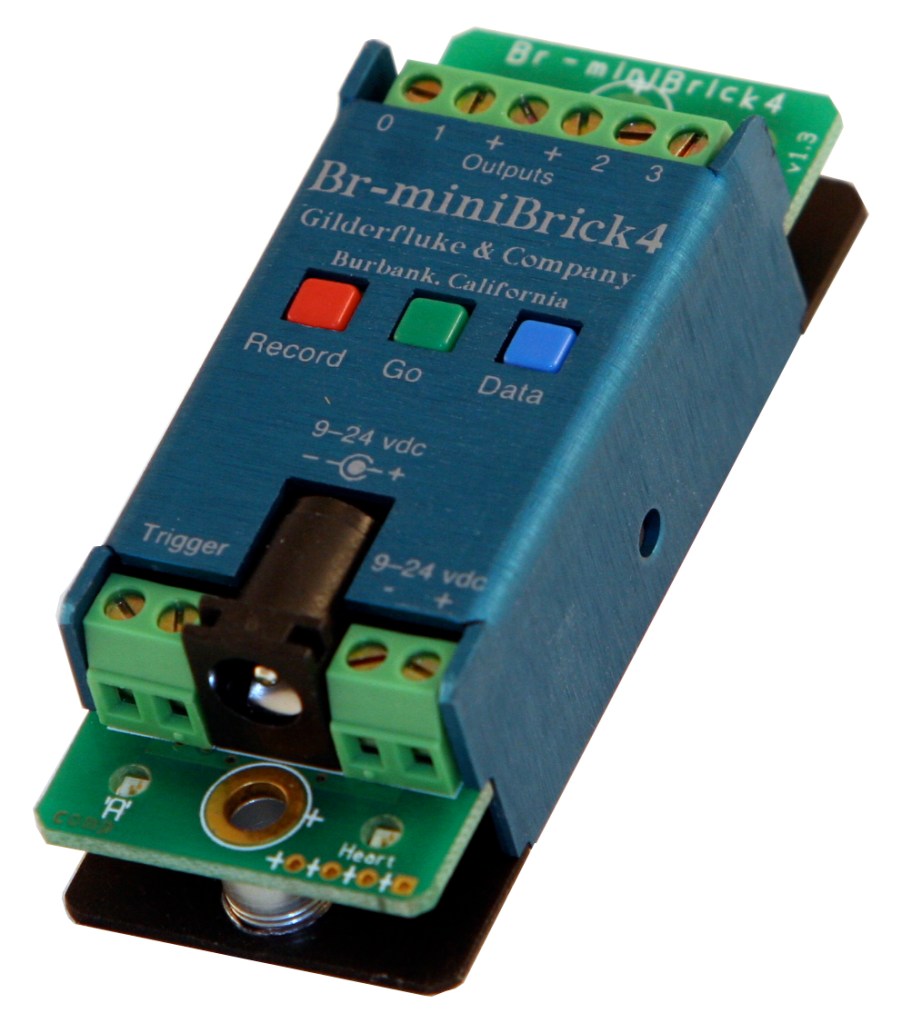
Looking for something a little more simple? But with similar *ooompf*? Here’s the Br-miniBrick4 breakdown:

Our miniBrick4 is super duper small. Small enough to fit in Baby Yoda’s hand with ease!

The Br-miniBrick4 is a complete stand-alone Show Control System. It features a single ‘trigger’ input, and four high current outputs for driving solenoids, lights and relays.

To program the Br-miniBrick4, simply press and hold the red ‘Record’ button until the first output starts flashing. Press again to step to the output you want to record. When you are ready to record, tap the green ‘Go’ button. Any previously recorded data will play back. If you press AND HOLD the ‘Record’ button, anything you do on the blue ‘Data’ button is recorded on this one output while the other outputs continue to play back. The Br-miniBrick4 will remember exactly what you do and precisely when you did it. You repeat this until you have all four outputs programmed just the way you want them. Features of the Br-miniBrick4 include:

  • Each Br-miniBrick4 has a show capacity of over four minutes at thirty updates per second! Once programmed, shows are retained for approximately forty years, with or without power applied.
  • One isolated input is used to trigger from push buttons, motion sensors, or any other kind of switch.
  • Each of the four outputs is rated for a continuous load of 250 ma., or one amp peak at 24 vdc. This is enough to drive small solenoid valves, relays, lights, and similar loads. The LEDs show all output activity.
  • High quality cage clamp-style screw terminals for all power, trigger, and output connections.
  • Runs on anything from 9 to 24 vdc, including batteries or solar cells.
  • Sturdy metal case mounts in 2.75″ ‘Snap Track’, with Velcro, double face tape or a pair of screws.
  • Optional serial port adapter (Serial Adapt 2)allows RealTime programming and ‘downloading in place’ through our easy-to-use PC•MACs software. This lets you program with greater accuracy, or program lots of Br-miniBrick4s identically! When downloaded, a Br-miniBrick4 can hold more than one show at one time and supports update rates from one frame per second to a maximum of one hundred frames per second. This allows you to program ‘delay’ shows that tick along at low frame rates between your main shows. The ‘Next’ show can be set for the end of any show, allowing you to build ‘chains’ of shows. Shows can be accessed sequentially or directly using the single input. The input can also be set to start, stop, pause, continue, or directly select a specific show.
Listen to the soothing voice of our Founder/CEO Doug Mobley as he talks you through the basics of the Br-miniBrick4

To add sound, use a Sd-10 or Sd-25-w/DMX Audio Repeater. If you need a few more inputs and outputs, consider our Br-MiniBrick8 or Br-MultiBrick32. For built in animation control, audio repeaters, amplification, and lighting control, use our Sd-50 series controllers.

To add sound, use a Sd-10 or Sd-25-w/DMX Audio Repeater. If you need less outputs, consider our Br-MiniBrick4. For more i/o, use the Br-MultiBrick32. For built in animation and lighting control, audio repeaters, and amplification, use our Sd-50 series of controllers.

NOW FOR THE FUN STUFF:

Look at that sight! Absolutely lovely! Hydraulic animatronic arm just waiting to plug into a miniBrick!

Our miniBricks were originally designed for animatronic control. They have been used in numerous animatronics all around the world, including in some famous magical attractions concerning a British boy with a scar on his head, some very famous droids, and some pretty sweet costumes that require various light and motion control (ideal for something like the Br-miniBrick4, since it’s so small you can build it into the costume with ease and no one would notice it’s there). Do you want to build your own Baby Yoda at home? Maybe you have an idea for some kind of Golum or elf? How about that weird character you thought of years ago but never built? The Br-miniBrick8 (or 4!) is your answer for controlling all those precise animations!

One such use was during the rise of Guitar Hero, a customer of ours rigged the Br-miniBrick8 to the Guitar Hero guitar, and the miniBrick hit all the marks, playing each song perfectly- allowing him to destroy the competition, thanks to our hardware!

The miniBricks have also been an excellent way to convince young and impressionable youth to get into the world of robotics, animation and animatronics. We’ve heard stories over the years of young future engineers getting a Br-miniBrick8 for the Holidays. After experimenting with our hardware, they ended up working for major companies such as Universal and Disney doing what they love- and the miniBricks helped them realize that passion.

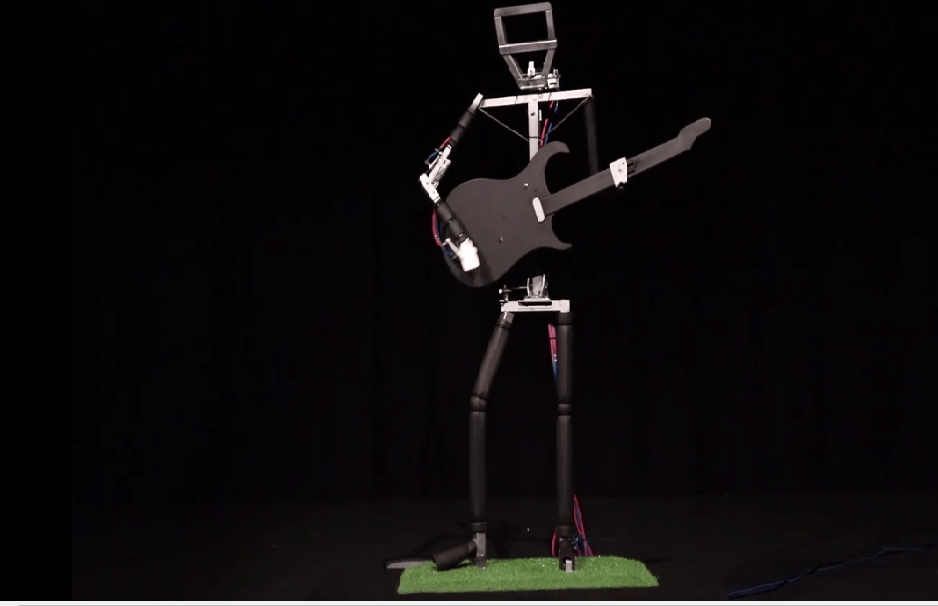
One pretty sweet example we received recently was from way down in Australia, a high schooler named Josh Beaman sent us this about an animatronic guitar playing robot he created using the Br-miniBrick8:

My animatronic character was designed to be a robotic entertainer, fitted with modern show control technology. The character is a life-sized guitar player that mimics the movements of a real guitar player, programmed to an audio track. I had aimed to create a humanoid structure that could be controlled as effectively as possible but relatively in-expensive materials and techniques.
The control board, being the Gilderfluke BR-MiniBrick8, is hooked up to an eight channel relay board to increase the amperage for solenoids since they needed more power to trip correctly and consistently. The MiniBrick using the PC-Macs software, runs all seven movements of the pneumatic character.

** I have also recently won the nationals with this project for the ‘Young ICT Explorers competition’, information can be found at this link;

Young ICT Explorers (He won 1st place for years 11 & 12!!!!)

** Since the Nationals were being held in another state, Sydney NSW, and I reside in Queensland, I was unable to attend, so the video in the folder was my entry into the competition & I won. It’s using a Beatles song, so I am not too sure on what the copyright laws allow? (It’s ok Josh, we will take the risk!)

** Finally, a big thanks to everyone at Gilderfluke. The only main concern I had with building and creating this project was the control system. Your company made the controller and programming phase of production a breeze due to all the helpful guidance and information provided for your control systems and boards.

Thanks again
Josh

Check out Josh’s super sweet project HERE

A little image/sneak peek at Josh’s first place project!

Everyone at Gilderfluke is so impressed and proud of Josh and his awesome work, we can only expect great things from him in the future! If he’s doing this as a teenager, imagine what he will do in his 30’s! He will be rolling with the best of them!

This also illustrates another key aspect of Gilderfluke- if you need help or advice with your product, call us! We are always open to assist you with whatever you want to create! Plus, it’s always great seeing the amazing projects and creations pumped out all over the world using Gilderfluke products!

If you are interested in checking out the miniBricks and all the other fabulous product offerings- check out our website!

Check us out next week as we plunge into the depths of the SER-DMX!

No comments to show.

February: Mini Brick Month!

Oh the joys of show controls! The month of February will go over our show control and ServoMotor products- which is a pretty sweet family of hardware.

Photo by Frank Zienert on Pexels.com

The series will cover the mini Brick 4 & 8 (show control), SER-DMX and the DAC-Quad (ServoMotors). This selection is excellent for show control, complex operations and, of course, super simple actions (ex. the mini Brick keeps certain lights blinking/flashing for years and years to the point that operators forget that it’s even using the mini Brick!).

Meet the mini Brick 8! It’s a great lifelong companion.

Our smart and dumb brick system for control of analog hardware, digital hardware, and audio provides off the shelf solutions for almost any animatronic show application. Paired with one of the industry’s best programming software packages, PC MACS, these products easily control any electronics needed for a show.

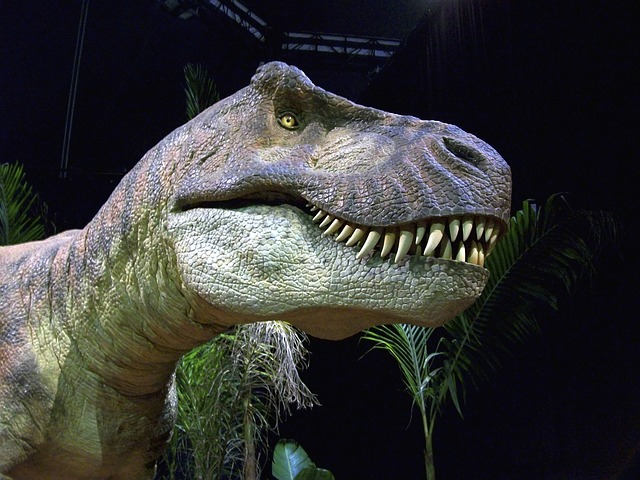
Want to control a huge, Jurassic Park-esque Dinosaur? Gilderfluke’s got you. Image from Jim Tsorlinis on Pixabay

We are one of the only companies that offers complete off the shelf solutions for professional animatronic control- and have done so for over 36 years. Our brick card systems control animatronic figures, stage, lighting, sound, and even special effects like fog, snow, and water fountains. These products have been used by some of the most popular, important and well-known theme parks and movies for years. Most of our equipment allows networking with their other cards through a DMX (RS-485) network. Many of our cards like the BR-Brain 4, SD-50 series and BR-minibrick8 can output DMX-512 data to command a show or animatronic figures. The programming is done up front, then downloaded to our cards so it can operate independently from a PC. If you wish to turn a PC into a show controller, the MACS-USB box is a full professional solution for programming or playing a large animatronic show.

A little reminder as to what a VHS looks like. Photo by Swapnil Sharma on Pexels.com

A little teaser example to give you an idea of the strength of these products- way back in the ye olden tymes of the 1990’s, when VHS’s ruled the galaxy, a gigantic VHS tape duplicate factory ran off of *one* mini Brick 8. The whole factory. One mini Brick. Not only did it run the VHS in order to be fed, recorded and copied, it checked the signals at the beginning, middle and end of each tape. If the tape wasn’t sufficient, it would be dropped in a fix/trash pile, and if it worked it would be dropped in the ‘good’pile.

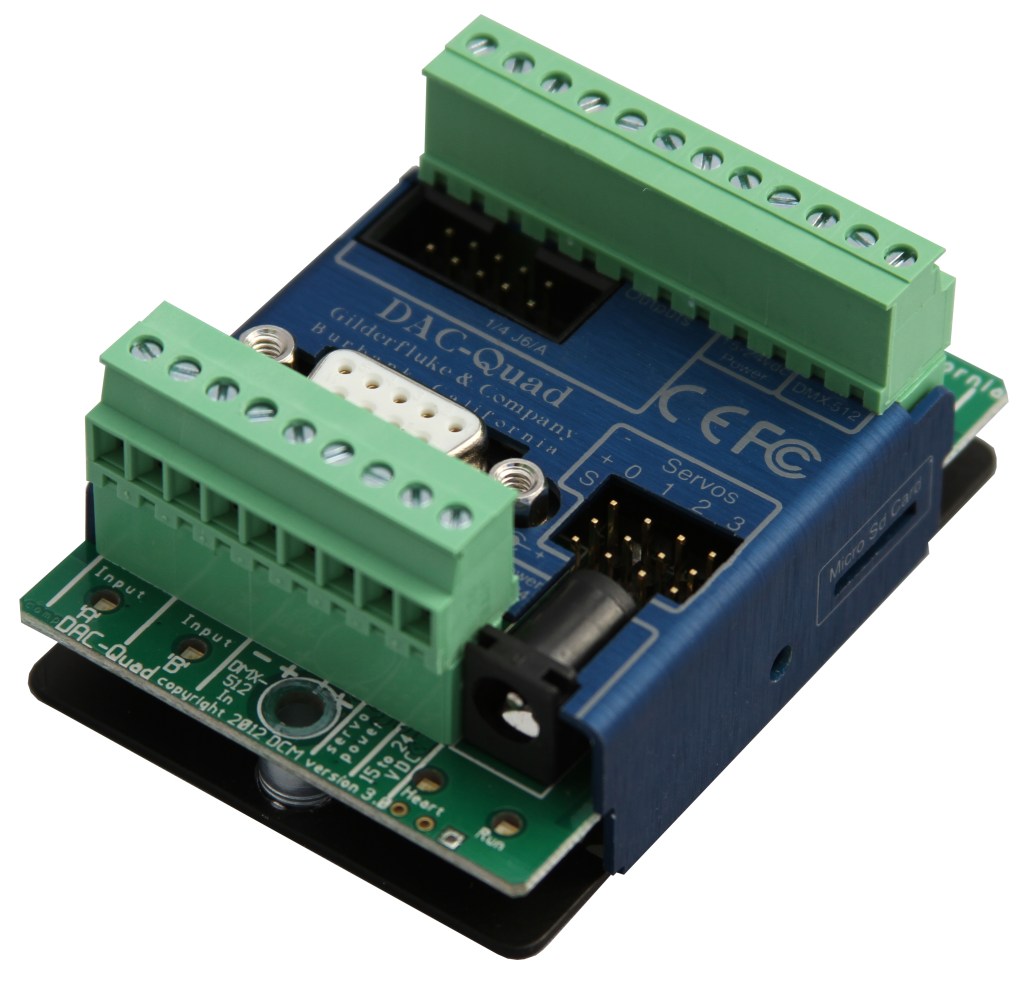
The DAC-Quad: Look at this little workhorse!

The DAC-Quad recently controlled a multi-ton, two-story tall unit for a production- basically acting as a live-control action swivel. It only required one little DAC-Quad for the whole job!

Next week, we will dive into detail about the mini Bricks 4 & 8! Then we will follow with some stories of the SER-DMX and the DAC-Quad to round out the rest of February. See you next week!

No comments to show.

The Amp-50: Powerful, Simple, Cool (Literally)

Look at all these pretty little speaker cabinets ready to be attached to an Amp-50!!
Photo by Mike on Pexels.com

Our Amp-50 is the final product in our SD line and easily the most straightforward: it’s an amplifier! Despite it’s simplicity, the Amp-50 is a pretty impressive tool to have around. It’s a 50 watt Class D amp — equivalent to a 250 watt linear amplifier.

Anywhere you need a strong solid state amplifier, the Amp-50 has your back- it can be used in Store-Casting, conference rooms, home theaters, car audio, museum, safety, haunt, industrial or entertainment applications. It can serve all these purposes without even getting warm.

Look at that fashionable ‘Classic Blue’!! (Pantone’s color of the year for 2020)– Really reinforces the fact that the Amp-50 stays cool- always.

The Details

The Amp-50 Class-D amplifier efficiency is nearly 90%. If you feed fifty Watts of 24 vdc into an Amp-50, you will get nearly fifty Watts into your eight ohm speakers. The supply current into a Class-D amplifier modulates to follow the sound exactly. If the sound is quiet, the supply current drops almost to zero. At full volume, it draws about two amps of 24 vdc, which is about equal to the 50 Watt rating of the amplifier (power = voltage x current).

Typical ‘Linear’ amplifiers have only about 20% efficiency. Fully 80% of the power you put into them goes into the heatsink as waste heat. A fifty Watt linear amplifier only feeds about ten Watts of power into your speakers, and forty Watts into the heatsink, whether or not there is any sound being fed through the amp!

Amp-50 Features:

  • An amazing fifty Watt Class-D stereo amplifier packs the power of a 200 Watt linear amp!
  • Low 0.1% THD+N distortion.
  • Integral Current Limit and Thermal Protection. Amp turns back on a moment after the fault is removed.
  • Works with most four to eight ohm speakers.
  • The amplifier can be bridged for a single fifty watt mono output into a four ohm speaker load.
  • Two RCA line level inputs for feeding in external line level audio signals.
  • Runs on any voltage from 12 to 24 vdc. Use a 60 Watt power supply (24 vdc at 2.5 amps) for maximum output. Universal input (90- to 24 vac input) power supplies are available from Gilderfluke & Company.
  • Low current draw makes the Amp-50 ideal for batteries or solar cells where line power is unavailable.
  • If running at high SPLs, use speakers that are rated for at least 100 Watts of continuous power.
  • As with any amplifier, speakers can be connected series/parallel to drive more speakers.
  • Sturdy aluminum enclosure. Mounts in 2-3/4″ Snap Track, DIN rail (with adapters) or just screw it down.
Here’s a breakdown of the Amp-50 in a sweet little video- accompanied by the Amp-50’s sister, the Sd-10!

Here’s a quick review of our whole SD line from InfoComm a few years back!

Interested in buying the Amp-50 for a show? How bout the Sd-50/40 for some crazy parades or stage shows? Maybe even just for around the house? Check out our website https://www.gilderfluke.com/ !! Have any specific questions? Want the sweet surrender of speaking to another human about excellent hardware? Call us! 1-800-776-5972 or 818-840-9484

Check out our post next week as we jump into our theme for February– our MiniBricks!

No comments to show.

Anything You Can Do I Can Do Better: The SD-50

Look at that sleek blue case! That durability– those inputs…those outputs… what splendor!

Let’s get the basics out the way: The SD-50/40 (and SD-50/08) is a complete stand alone stereo audio playback system with 40 Show Control Outputs (the /08 has eight control outputs). The show control and DMX-512 output options make it into a complete Audio and Show Control solution.

  • Adds forty digital (on/off) Show Control outputs to the Sd-50. Eight of the outputs can be used for controlling eight model airplane-style ServoMotors
  • Optional GPS clock (Sd-50/GPS40) for triggering using a 365 day schedule or by location
  • Locations where sounds and shows are played are set using Google Earth
  • DMX-512 inputs for controlling Animation & Audio. DMX-512 outputs for up to 512 channels
  • Automatic “program in place” download through your PC’s serial port or the MMC/SD card. Draw the sequence you need on your computer using our easy-to-use PC•MACs software, or with “Hardwareless RealTime” mode, program using the PC’s mouse and keyboard
  • Four MBytes of nonvolatile Show Control memory. Using all forty (or eight) SD-50 (/40 or /08)Show Control outputs, this gives a show capacity of about eight hours at thirty updates per second! Once downloaded, show data is retained for approximately forty years.
  • Networkable: Four optoisolated inputs can be used to start, stop, pause, continue, or access shows
  • Show Control outputs are each rated for 150 ma. continuous, or 500 ma. peak. This can drive small solenoid valves, relays, LEDs, lights and other similar loads
  • Program shows a year in advance- 365 day scheduling allows for show changes and adjustments any time within a year.
Check out this most excellent brown bag seminar video detailing the SD-50/0 (base model)

So how does this translate to real-world use? Well, there’s all kinds of really cool uses we’ve found for it so far, and we guarantee it can do more than what we can even comprehend. The only limit… is your imagination (or lack of hardware!)!

An *outrageously* simple fountain by SD-50 standards, but it’s still pretty!
Photo by Marcus Herzberg on Pexels.com

One of the most basic and common uses for the SD-50’s is fountains. This product rocks it in this category- synchronize the water displays, lights and sound to make the most intriguing water displays. Thanks to the addition of the atomic clock input- even super complex synchronization can be achieved. One client had four fountains at a major intersection and wanted them to work in sync together. A pretty sweet idea, except they were initially told they were going to need a pretty expensive and large system installed directly under that intersection- requiring construction and all the problems that come with it. Beyond all the practical issues- it was quite expensive. In comes the heroes at Gilderfluke with the SD-50’s! Since the GPS antenna connects with the satellites above, each fountain connected to the SD-50 were easily set up to work together, controlling the lights, sounds and water displays in sync with no construction and far less hassle.

Want to ride this til you puke? The SD-50 will help you achieve that goal.
Photo by Tim Gouw on Pexels.com

Another major use for the SD-50 is roller coasters. Whole rides run off this one 2-1/4”x 5-1/4” rectangle. The SD-50 is uniquely useful for this task not only because it seemingly does everything (it can’t/won’t find you a girlfriend) but due to its demonstrated durability and resilience. The product can handle the intensity of roller coasters, moving every day all day at extreme speeds in all kinds of weather. It’s built to last. Just take her down and clean her up periodically to prevent any build-up from the elements (and you don’t even need to do that often!).

From the Crystal Cathedral to thousand year old Churches, we will keep your bells ringing perfectly on time for eons!!
Photo by Fredrik Rubensson on Pexels.com

Interestingly enough, another very common use for the animation outputs for church bells! It can be set up to ring the bells that have been on that church since the dawn of time or to project bell tolls through the SD-50 itself. Given less and less churches want to require an alter boy or hunchback to toll the bells hourly or for mass-the SD-50 is an exceptional replacement. This is another example of using the atomic clock, since it automatically connects with all other clocks in sync with the GPS satellite, the time accuracy is correct within 1/1000th of a second. The illustrate this point, in a small, Midwestern town there stands two churches on opposite sides of town from each other. Without the other one knowing, they both got SD-50’s to control their church bells which made for a fun byproduct– they chime together, every hour on the hour- perfectly in sync despite the fact they have nothing to do with one another.

More generally, the SD-50 is also used in very complex parades to ensure proper timing for lights, sounds, music and animation. It’s also extremely useful for theme park attractions, some very popular magical attractions almost exclusively run off SD-50’s. Beyond the awesome multi-control capabilities that allow such attractions to run all day every day, the SD-50 provides 365 day programming, so you can schedule a change or an all new show to happen at any specific moment between now and a year from now. This is particularly advanced since most other mechanisms hold up to one week of scheduled programming at a time- which is nice because you can set it and forget it!

As you can see, there are a pretty sweet variety of things you can do with this product! Even though we have a hearty variety of stories of the SD-50 working its magic worldwide– we love to hear more stories from customers who’ve used it! Don’t hesitate to tell us your story! You may just be highlighted in an article or future blog post!

Here’s a little overview on the whole SD family of products! Want to just learn more about the SD-50? Go to the 6:00 time stamp.
No comments to show.

Halloween Haunt in 2020

As we get closer to Halloween, for the month of September we at Gilderfluke are asking what the world of Haunt is doing in the face of COVID? As entertainment behemoths like Universal, Disneyworld, and Knott’s Berry Farm are canceling their Halloween festivities entirely, we ask where will thrill-seekers go for their favorite spooky holiday?…

IAAPA Asia Supplements

Hello friends and family worldwide! We are presenting at IAAPA Asia (virtually) and are uploading some info here on the blog. Please check out our newsletter if you haven’t seen it! Check out our Newsletter! It gives a nice overview of some key products, along with a product comparison chart for your consideration! 查看我们的新闻通讯!它提供了一些关键产品的概述,并提供了产品比较表供您考虑!

Br-miniBricks Make the World Go-’round

News and Updates! The Br-miniBricks 4 & 8 have been essentially unaltered for the last 15 years- until today! We have new manuals for the Bricks coming up on Gilderfluke’s website in the next couple of days (so definitely check it out!). One of the cooler additions to the manual is where it illustrates how…

Small & Mighty: The SD-10

She may be small (roughly the size of a 9 volt battery) but she is powerful. Sturdy. Strong.

The SD-10 came about as a result of mass customer requests to have simplified versions of the SD-25. As a result, the SD-10 and the AMP-50 were born! The SD-10 is simply the audio player from the SD-25, and the AMP-50 is, well, the segmented amp.

Our mini titan is used worldwide for a variety of unusual and entertaining jobs, and one of it’s uses doesn’t necessarily involve audio! The most common and simple use, obviously, is an audio player. The SD-10 will hold pretty much any standard SD card- it has held up to a 64G SD without issue. It was created a bit before the advent of the huge, gigantic SD cards of 2020, but 64G is pretty reasonable in our humble opinion. You can use it for sequential and random audio playing in whatever set up you have! For more fun uses, the SD-10 is used for custom doorbells, phone ringers and interestingly enough, can be used as a time code generator! A particular entertainment company with worldwide interests in theme parks uses the SD-10 for just that! Thousands of them, in fact! At around a tenth of the price of an actual time code generator, it’s a pretty sweet deal to keep everything running in sync!

Here’s a quick little video intro!

ch-ch-ch-check it out! a simple little intro to our SD-10! small, but mighty!

Want to know more about our SD series in general? Here’s a little video to tickle your interest!

All the audio products your heart and ears could ever ask for!

Have you used the SD-10 or any products from our audio line? Message us! Comment below! We love to hear stories from customers. Maybe YOU and your story could be featured on the GilderBlog!

No comments to show.

SD 25 with DMX: Play, Repeat, Enjoy

2020 is a very fashionable year for the SD-25, did you know the Pantone color of the year is ‘Classic Blue’? While Gucci and Hermes try to inject that color into their fashions, Gilderfluke has been rocking Classic Blue for decades!

The SD-25 with DMX is a complete stereo audio playback system. It can be used in a variety of features including Store-Casting, Music-On-Hold, Museums, Safety, Haunt, Industrial or Entertainment applications. Anywhere you need a solid state, high quality audio system that will play for years.

Basic Breakdown

  • DMX-512 input can be used to select and play 255 SoundFiles using just one DMX-512 channel. Using two addresses, you also get live volume control via DMX-512. Two RJ-45 jacks to make networking easy
  • RS-232 and IR ports, which were options on the earlier SD-25s, are now standard on the SD-25 w/DMX
  • Stand alone stereo playback of standard Mp3 (all data rates) or .WAV audio files (up to 48K/16 bit) stored on standard Secure Digital (SD or SdHC) cards. Up to 255 Files in most modes, 32,737 in some.
  • Use an Apple remote to play sounds and adjust volume levels. Use IR-Tx‘s for ride vehicle audio triggers
  • An amazing 50 Watt Class-D stereo amplifier packs the power of most 200-250 Watt linear amps! It draws only a fraction of the power of a typical amplifier, and only when it is pumping sound. Works with most 8 ohm speakers. The amplifier can be bridged for
  • Two RCA jacks for input or output of line level audio signals. Works with external amps or audio sources.
  • All configuration is through externally accessible switches. No PC software or drivers are ever needed.
  • LEDs show triggers, DMX-512, heart and SD card activity. Modulation LEDs show audio as it is played.
  • Two non-polarized optically isolated triggers. Attaches to PLCs, switches, motion detectors, IR sensors, alarm systems or other controllers. Inputs can be set to ramp audio or to select and play specific sounds round-robin or randomly. StoreCasting and Mus
  • Mounts in Snap Track, DIN rail (optional), or just Velcro or screw it down. Mounts nicely in a 4×4 J-Box.
  • Optically isolated ‘running’ status output can be used to turn on lights, relays, audio ducking, etc…
  • Built in RS-232 serial port can be used to control volume, call up sounds and monitor the SD-25 w/DMX
  • Runs on any voltage from 12 to 24 vdc. Draws 2.5 Amps at 24 volts (50 Watts) at max amplifier output
  • Low current draw makes the SD-25 w/DMX ideal for batteries or solar cells use where line power is unavailable.
  • ‘Starter Kit’ is available: Includes the necessary accesories (USB flash card reader/writer, power supply, MC-Sd Flash Card, Small Screwdriver and GilderCD with software) to operate the SD-25 w/DMX

Real World Implications

So you have the numbers and stats about the SD-25 with DMX. But what does this all amount to when you’re using it in the real world?

Recently at one of our projects for a local Museum, they required an SD-25 with DMX for an interactive earthquake display. It used a pair of 4′ Cerwin-Vega SenSurround subwoofers, the system used a pseudorandom noise generator with output frequencies between 17-120 Hz to feed 1,600 watt BGW-750 audio amplifiers driving the 8 ohm subwoofers. We hooked them up to the SD-25 with DMX along with a sampled rumble through a pseudrandom noise generator- in order to produce a nice rumble sound to accompany the moving platforms, lights, video and other audio guiding the audience through a simulated earthquake. The two 4′ x 4′ x 30″ subwoofers stacked on top of each other sat in the same spot since they were moved to the museum 22 years ago. When attached to one of the SD-25’s stereo amplifier terminals, it ended up being so loud that the subwoofers began to walk forward from the intensity. As a result, the museum now has a leash to hold them back and stable! We also should mention the sound effect is only on for about 20 seconds per ‘earthquake’, further illustrating just how powerful the SD-25 with DMX is!

Imagine how many leashes you’d need to hold back the subwoofers used in a full-on metal show if connected to an SD-25 w/ DMX! The dancing subwoofers could be part of the stage show! (Photo by Thibault Trillet on Pexels.com)

Check it out!

Welcome to the GilderBlog

As we move through 2020 and beyond, we here at Gilderfluke want to better show our products and their capabilities in a multi-dimensional way. So we created a blog.

Every month will have an overarching topic, and each week within that month will expand on each major element of the topic in question. If you have any questions, curiosities or even requests don’t hesitate to comment and let us know!

Follow the blog, but also follow our other social media accounts below!

No comments to show.
Design a site like this with WordPress.com
Get started